Information from dk-verband.de
ORIGIN: Germany.
USE: Versatile hunting dog.
SHORT HISTORICAL OVERVIEW
The story of the German shorthair begins with the dogs that were used in the hunting of feathered game, especially in the Mediterranean countries, and in the hunting. Via France, Spain and Flanders, the steeh dogs came to the German princely courts. The most important characteristic of these dogs was their performance. Moreover, a protruding dog was required after the first double shotgun (1750) was made. In front of the dog, “flying game in flight” was killed. This was the beginning of the transition from a pure leading dog to a versatile hunting dog. As a decisive document for the structure and development of the breeding, the “Schlegerbuch Deutsch Kurzhaar” has been published since 1897. It was Prince Albrecht zu Solms-Braunfeld who established breed identifiers, assessment rules of body shape and finally also simple examination rules for hunting dogs. Today, the German shorthair passes through the filter of a sophisticated breeding and examination regulations. The standard determines how the versatile hunting dog Deutsch-Kurzhaar should be. This enables him to meet all requirements in hunting until old age.
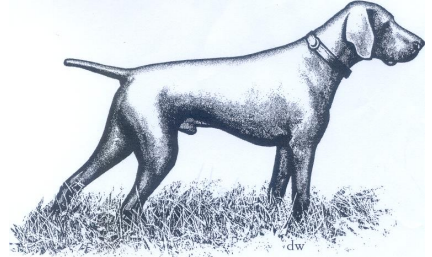
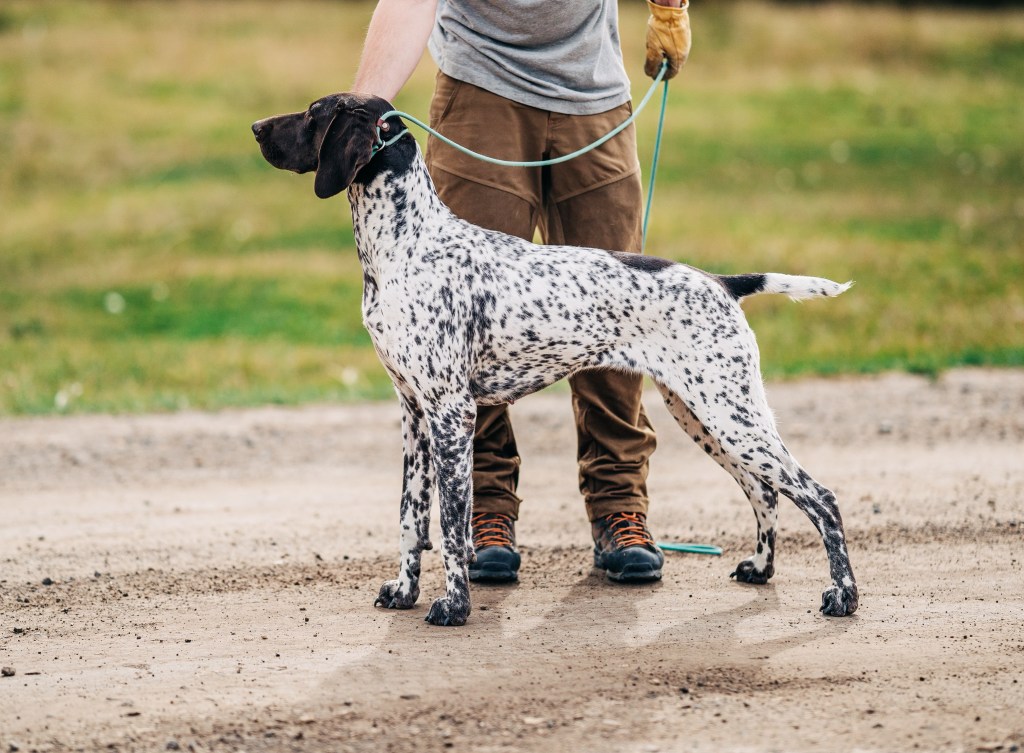
GENERAL APPEARANCE
Noble, harmonious dog, whose physique ensures strength, endurance and speed.
Upright posture, flowing outer lines, dry head, well-worn rod, tight, shiny fur and spacious harmonious movements underline his nobility.
IMPORTANT PROPORTIONS
The hull length should exceed the height of the withers a little.
BEHAVIOR / CHARACTER (ESSENCE)
Firm, balanced, reliable, restrined temperament, neither nervous, shy nor aggressive.
HEAD: Dry, striking, neither too light nor too heavy; in strength and length corresponding to body shape and gender.
Skull: Sufficiently wide, flat arched skull, weakly pronounced uteral sting, forehead furrow not too deep, recognizably developed eyebrow arches.
Stop: Only moderately trained.
FACIAL SKULL
Nasal sponge: Slightly pruding. Nostrils sufficiently wide, wide and mobile. Basically brown, but black with black dogs or black mold. Only with white base color is a flesh-colored or spotted nose allowed. Catch: Long, wide, deep and strong to make it easier for the dog to properly carry the game. The bridge of the nose, seen from the side, shows a slight sorture in all transitions from a noblely shaped ram nose to a small elevation over the straight line, more pronounced in the male. The also still permissible completely straight nose bridge line is less appealing, a bent (concave) nose bridge is a serious mistake.
Jowls: Atting, not too strongly overhanging, well pigmented. Fall off almost vertically from the nose to the separation point, then go in a flat arc to the moderately pronounced angle of the left.
Jaws / Teeth: Strong jaws with a perfect, regular and complete shear bit, with the upper row of incisors reaching over the lower jaw without gap and the teeth being approximately vertical in the jaw; with 42 healthy teeth, according to the tooth formula.
Build: Strong, well muscled.
Eyes: Of medium size, neither protruding nor low lying. The ideal color is dark brown. The eyelids fit well.
EARS
Moderately long, high and wide, smooth and without rotation hanging close to the head, bluntly rounded at the bottom. Neither too meaty nor too fine. It should, placed forward, cut off approximately with the angle of the lip.
NECK
Length in harmony with the overall picture, gradually widening towards the torso. Neck very muscular and slightly arched. Tight-fitting throat skin.

Body
Top profile line: Straight and slightly sloping.
Withers: Clearly.
Back: Firm, well muscled. The thorn processes should be covered by muscles.
Loin: Short, broad, muscular, straight or slightly curved. Transition from back to lumbar tight and well closed.
Croup: Wide and sufficiently long, not short and only slightly sloping towards the rod, well muscled.
Chest: More deep than wide with a well-developed fore-breast and as far back as possible. The sternum and elbow joint should be at the same height. Ribs well arched, neither flat nor barrel-shaped. Rear ribs well down. Lower profile line and
Belly: In an elegant arch slightly raised running backwards, dry.
TAIL
High set, strong at the base, then tapering, medium length. For hunting use cut by about half. Hanging down in peace, in the movement horizontal and not too high above the back line or worn strongly curved. (In countries where the legislator has issued a ban on rod clipping, the rod can remain natural. It should reach up to the ankle joint and be worn straight or slightly saber-shaped).
LIMBS FOREHAND
General: Straight and parallel seen from the front; well under the body, well under the body.
Shoulder: Oblique and rearward flat shoulder blade. Strong, dry muscles. Good angle between shoulder blade and upper arm.
Upper arm: As long as possible, well and dry muscular. Elbow: Adharent to the body, but not pressed, neither outward nor inward, placed far back. Good angle between upper arm and forearm.
Forearm: Straight, sufficiently muscular. Strong, not coarse bones. Anterior tarsal joint: Strong.
Forefoot : Minimal angle of the forearm and forefoot, never steep. Front paws: Round to spoon-shaped, with close to each other, sufficiently arched toes. Strong toe claws. Coarse, resistant bales. They are parallel, in the standing and in the movement neither inward nor outward facing.
HINDQUARTERS
General: Viewed from behind straight and parallel. Good angles. Strong bones.
Thighs: Long, broad and muscular. Good angle between pelvis and thigh.
Knee: Strong, with good angle between the upper and lower legs.
Lower leg: Long, muscular and senduous. Good angle between lower leg and hind foot.
Ankle: Strong.
Posterior middle foot: vertical, strong.
Hind paws: Round to spoon-shaped, with close-fitting, sufficiently arched toes. Strong toe claws. Coarse, resistant bales. They stand parallel, in the stand and in the movement neither inward nor outward direction.
Movement: Spatially grasping, with a lot of thrust and appropriate advance, straight and parallel in front and back hand; with a well-erected posture. Passing is undesirable.
Skin: Tight-fitting, without wrinkling.
COAT
Coat Consistency: Short and dense, should feel rough and hard. At the head and at the hanging it should be thinner and shorter, at the bottom of the rod not noticeably longer. It is supposed to cover the whole body.
Skin: Tight-fitting, without wrinkling.
Color:
- Black paint in the same shades as the brown or brown. Brown roan paint.
- Brown, without badges.
- Brown, with minor white or mottled markings on chest and runn.
- Dark brown roan with brown head, brown plates or dots. The basic color of such a drawn dog is not brown with white or white with brown, but the hair shows such an intimate mixture of brown and white that it creates that for practical hunting use so valuable, inconspicuous exterior. On the inside of the hind legs as well as on the tip of the rod, the coloration is often lighter.
- Light brown roan with brown head, brown plates, dots or without plates. With this coloring, brown hairs are present to a small extent, white hairs prevail.
- White, with brown head drawing, brown plates or dots.
SIZE
Height: males: 62 to 66 cm, females: 58 to 63 cm.
Faults
Any deviation from the aforementioned points must be regarded as an error, the assessment of which should be in precise proportion to the degree of deviation and whose influence on the health and well-being of the dog should be taken into account.
- Error in the gender type.
- Catch too short.
- Too strong or too little reflection.
- If there are no total of 2 teeth (P1 and M3), i.e. of a total of 4 P1 and 2 M3, no more than 2 teeth may be missing.
- Too bright eye. Light yellow bird of prey eyes.
- Too long, too short, too heavy, too narrow or twisted curtain.
- Loose throat skin.
- Light carp back.
- Too short croup.
- Chest too deep.
- Tail carried too high above the back line or heavily curved.
- Elbows turned outward or inward. Toe-tight or toe-widden, floor-tight or floor-wide.
- Steep hindquarters.
- Slight sale, slight cow snighness or tightness.
SERIOUS FAULTS
- Deviations of more than 2 cm from the mentioned heights of the withers.
- Heavy, lymphatic gross bone body.
- Pronounced stop
- Flesh-colored or spotted nose (except for white base color).
- Sharp catch.
- Curved (concave) bridge of the nose.
- Plier bite and partial pliers. (In dogs older than 4 years has a so-called. Age tongs have no influence on the rating, provided that a German short-haired club confirms that a correct detition was found at a previous breeding show).
- Clear carp back. Lightly sunk back.
- Significant lack of chest depth. Uncharacterized forebreast. Too flat or barrel-shaped chest.
- Strongly outward or strongly inward turned elbow joint.
- Soft, too overstretched anterior foot root joint.
- Steep front midfoot.
- Strongly cow-heated or strongly barrel-legged, both in standing and in movement.
- Built-in rear hand.
- Spread toes.
- Flat paws.
- Cumbersome gait.
- Deviations of more than 2 cm from the mentioned heights of the withers.
DISQUALIFYING FAULTS
- Aggressive or overly fearful dogs
- Dogs that have clear physical abnormalities or behavioral disorders.
- Gross deviations from gender type.
- Absence of more than 2 of the total 4 P1 and 2 M3. Absence of a tooth or several teeth (except P1 and M3).
- Non-visible teeth are considered missing teeth, unless a German Shorthair Club confirms that their presence was determined at a previous breeding show or breeding test.
- Fore- and back bite, cross bite and all transitional forms.
- Excess teeth, outside the row of teeth.
- Jaw and lip slit.
- Strongly loose eyelids, ectropium, entropium, distichiasis (double lash row).
- Strong sunk back. curvature of the spine;
- Deformed chest, e.g. “disposed chest”.
- Wolf toes and wolf claws.
- Any kind of weakness.
N.B.
- Males must have two obviously normally developed testices that are completely in the scrotum.
- Only functionally and clinically healthy, breed-typical dogs should be used for breeding.
 Vom Tetontal